“Eastward Learning in the Age of AI”: How “Axis of Becoming” Uses Eastern Wisdom to Reimagine the Next Generation of Educational Games
As generative artificial intelligence rapidly enters classrooms, learning platforms, and educational applications, the field of educational technology is beginning to diverge in visible ways. On one side are products centered on efficiency, assessment, and task completion. On the other, a smaller but growing group of experimental projects is emerging projects that place greater emphasis on experience, reflection, and the construction of meaning.
“Axis of Becoming”, an interdisciplinary project initiated by a team on the U.S. East Coast, belongs to the latter category. Designed as an AI-powered cross-cultural serious educational game, the project attempts to combine Eastern philosophy, arts-based healing practices, and interactive digital storytelling. In doing so, it raises a less commonly asked question: in the age of AI, can technology not only accelerate learning, but also help people slow down, and reconsider their relationship with themselves and the world?
A Different Path: From “Learning Faster” to “Perception and Reflection”
As generative AI continues to reshape global technological landscapes, the boundaries of education are being redefined at an unprecedented pace. While algorithmic efficiency and task-driven logic increasingly dominate digital education, an international interdisciplinary team led by prominent scholars is attempting to carve out something different: a digital environment infused with elements of Eastern philosophical thought and humanistic reflection.
This effort has taken form in “Axis of Becoming”, an AI-driven cross-cultural serious educational game grounded in philosophical inquiry. The project represents not only a rethinking of conventional educational tools, but also a deeper exploration of how technology might serve human consciousness rather than merely optimize performance.
Within today’s educational technology ecosystem, words such as “faster,” “more accurate,” and “measurable” often define success. Completion rates, shortened learning paths, and visible progress bars shape the design of most digital platforms. “Axis of Becoming”, however, shifts attention in the opposite direction. As learning accelerates, the project asks: do learners still retain the space to engage in dialogue with their own experiences? When interactions are structured as continuous chains of tasks, can individuals still pause, sense, hesitate, and reflect?
From this perspective, “Axis of Becoming” is not simply a tool but a philosophical proposition about the future of education. It asks whether technology can become a vessel for human cultural experience and reflective awareness—not merely a mechanism for efficiency.
Reimagining “Eastward Learning” and Cultural Dialogue in the AI Era
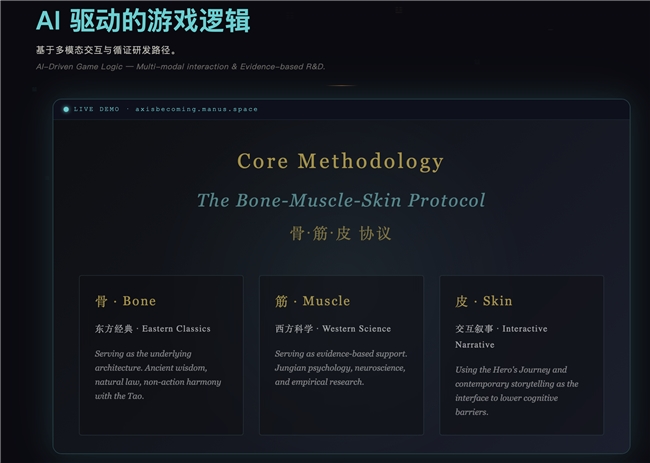
The first phase of “Axis of Becoming”, titled “Sumeru: One Thought, One Thousand Worlds”, presents an ambitious vision that differs from mainstream educational technology development. Rather than focusing solely on skill training or language instruction, the project seeks from the outset to integrate relational thinking, holistic perception, and aesthetic awareness from Eastern philosophical traditions into digital learning systems historically shaped by Western rationalism and efficiency-driven models.
This vision is the result of years of interdisciplinary research in cross-cultural education and AI-assisted learning. Behind the project stands a team that has long explored the intersection of digital pedagogy, cultural dialogue, and technological experimentation.
An Interdisciplinary International Team
“Axis of Becoming” was initiated by an interdisciplinary research team active across the U.S. East Coast. Based in the Boston-area academic ecosystem, team members are affiliated with multiple education and technology research institutions, including Northeastern University, Harvard University, the Massachusetts Institute of Technology (MIT), and the University of Massachusetts Amherst (UMass Amherst). The team spans game design, education, psychology, linguistics, and related fields, bringing a genuinely cross-disciplinary approach to research and development.
The project’s lead creator, Dr. Ann Cai, is a professor at Northeastern University. She holds a doctorate in Educational Psychology and a Master’s degree in Computer-Assisted Instruction. Over the course of her academic career, Dr. Cai has also taught at Harvard University and the Massachusetts Institute of Technology. Her teaching has been recognized with the Harvard University Excellence in Teaching Award.
For many years, Dr. Cai has explored models of Human–AI Co-learning, examining how artificial intelligence can collaborate with human learners rather than merely deliver information.
Technology Meets Zen
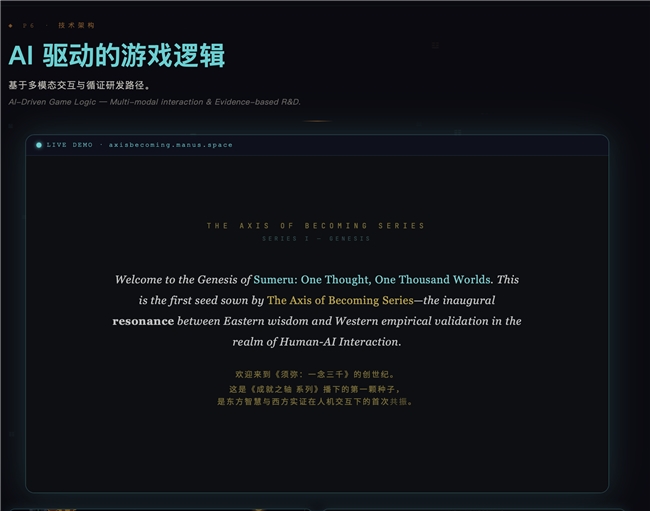
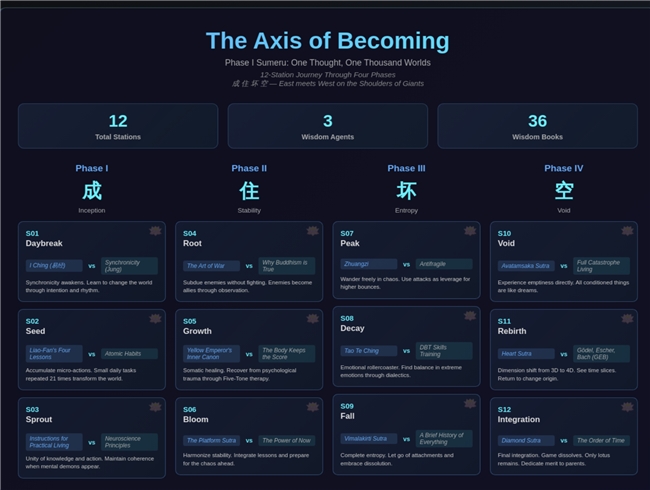
As a cross-media narrative experience exploring the convergence of Zen philosophy and contemporary scientific thought, “Axis of Becoming” constructs a richly layered digital landscape. Players move through a virtual world known as Sumeru, where each small decision or pause reflects the philosophical idea that a single thought can generate countless worlds. The design emphasizes open-ended exploration and contemplative immersion rather than task-driven progression. Users encounter a meditative digital space shaped by visual atmosphere and nonlinear narrative interactions.
Li Hou, an academic collaborator on the team and a Digital Storytelling (DST) researcher and writing program instructor at the University of Massachusetts Amherst, explains that as the team co-developed papers and refined the project’s research framework, they increasingly felt that the name “Sumeru” carries a layered cultural resonance. In traditional Eastern cosmology, Mount Sumeru is often understood as the center of the world, an image that connects heaven, earth, and all phenomena. By drawing on this concept, the team is not simply “branding” with cultural symbols; rather, it is attempting to build a narrative structure of “center and relationality” in digital space. Each choice, each pause, can resonate with other experiences, gradually forming an expanding web of understanding. As the Buddhist metaphor of “one thought, three thousand worlds” suggests, even a small moment of attention can open into a new world. For the team, this is not only a narrative method but also an educational stance: learning is not merely the accumulation of knowledge, but a process through which understanding continuously takes shape.
Arts-Based Healing
As artificial intelligence becomes more deeply integrated into educational systems, new challenges are emerging. Improvements in learning efficiency do not necessarily translate into stronger motivation, while rising levels of academic pressure and information overload have increased concerns about students’ psychological well-being.
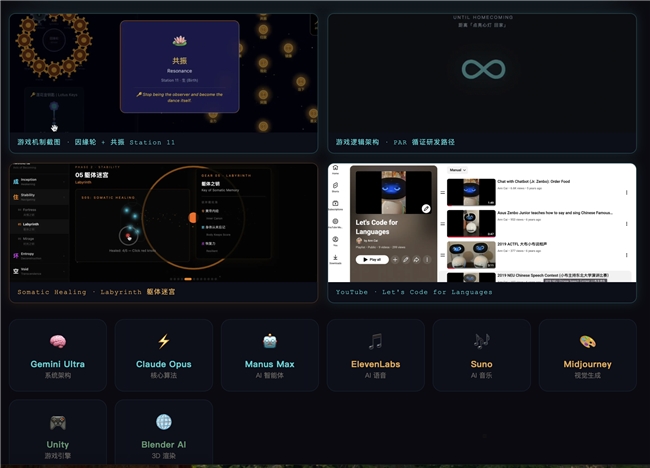
Within this context, the project integrates arts-based healing practices such as visual arts therapy, rhythm-based musical healing, movement-based dance therapy, and Digital Storytelling (DST). Through creative expression, learners reconnect emotional awareness, bodily experience, and cultural imagination.
Data and User Experience
Internal testing reports indicate that the interaction design has produced observable behavioral changes among users. Even without explicit instructions or reward mechanisms, participants demonstrated spontaneous slowing down: movement speed decreased, dwell time increased, and exploration became more reflective.
A large-scale example occurred during the “Lighting Ceremony” held on February 22, 2026, when more than 500 participants from around the world entered the game environment simultaneously in a synchronized online experience.
Looking Ahead
Looking forward, the “Axis of Becoming” team is preparing broader global academic collaboration. In the Boston and New England regions, the team plans to work with universities and research institutions to develop systematic training pathways for arts-based healing education.
For the team, “Axis of Becoming” represents not only a digital educational game but also an experiment in the future form of education, one that asks whether technology can help create spaces where the human mind slows down and deeper cultural understanding can emerge.
(Images below: Concept design and demo screenshots from the educational game Axis of Becoming.)