Many audiences exclaim after watching a concert: “That laser light projection is amazing!” In fact, there is a common technical misunderstanding here. In the professional performance field, “laser projection” and “laser show” are two completely different systems with clear divisions of labor, and neither can be dispensed with.
Laser Projector: Its role is a “painter”. It uses a high-power laser as the light source (replacing traditional light bulbs) and projects images onto large LED screens, gauze screens or building facades through its internal optical engine. Its advantages lie in extremely high color purity, long service life and stable brightness, which can present delicate video images, such as close-ups of singers and complex animated backgrounds. However, the light it produces is “scattered”, and the light beam cannot be seen in the air.
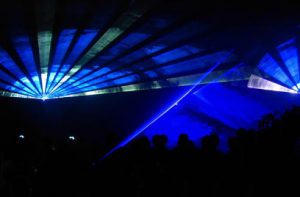
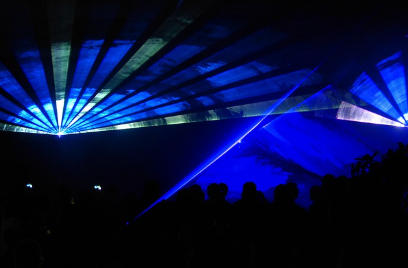
Performance-Grade Laser System: Its role is a “sculptor”. It does not project images, but directly emits high-energy-density parallel light beams. Controlled by high-speed galvanometers, these light beams can “carve” three-dimensional tunnels, grids, texts in smoke, and even simulate the effect of traveling through time and space. Only this kind of system can let you see that sharp green light cutting through the night sky.
In modern top-tier concerts (such as Taylor Swift’s or Jay Chou’s tours), the director will dispatch these two systems simultaneously: the background large screen uses laser projectors to ensure 4K high-definition image quality, while the aerial special effects use performance-grade lasers to create a sense of immersion. Understanding this difference is the first step to appreciating the stage design of a concert.